Interim management software: assignments and timesheets The shortlist in one search.
No ringing round the pool.
The manager declares their own availability and enters their days. Search covers your CVs and interview notes, the client signs the timesheet online, and the invoice goes out without re-keying.
Marvin is software for interim management firms: pool of managers, assignments, timesheets and invoicing in the same tool, hosted in France. Margin is tracked per assignment, per manager and per client, and profiles come out with your logo and colours, in PDF or Word.

Camille RousseauChair · Aerolys · call, Monday 10 am
“Our CFO leaves in three weeks. We need someone for six months while we recruit.”
 Banking


 Antoine LefèvreFormer CFO, industrial group
- Free from
- Oct 14
- Updated
- by him, 3 days ago
- Day rate
- €1,300
 Julie MoreauCFO, 3 industry assignments
- Free from
- Oct 21
- Updated
- by her, yesterday
- Day rate
- €1,250
 Paul BergerCFO, turnarounds
- Free from
- Oct 28
- Updated
- by him, 5 days ago
- Day rate
- €1,150
CV and profile reformatted from the record, anonymous version if needed, in PDF or Word.
7 → 1subscriptions replaced by a single licence
Manager portaleach manager declares their own availability and days
Double approvalof timesheets, by your team then by the client, online
Margin trackedper assignment, per manager, per client
The assignment, from first contact to invoice
One assignment, one pool, one invoice.
Without switching tools.
For an interim management firm, Marvin follows the mandate end to end: the manager declares their availability in their own space, search goes through their CVs and your interview notes, the profile comes out in your branding, then the client signs the timesheet online and the invoice is generated from the approved timesheet.
The poolThe pool keeps itself up to date.
People · manager's spaceEach manager has their own space, opened through a secure link, no password. They declare there whether they are free and from when.You only call those who are free: the time spent requalifying on the phone goes back into business development.SearchThe shortlist is built in hours.
Search · interview notesAn assignment comes in. Search reads the text of CVs and interview notes, with the synonyms of the trade: in interim management, what matters rarely fits in a job title.The availability declared by each manager is added as a filter.
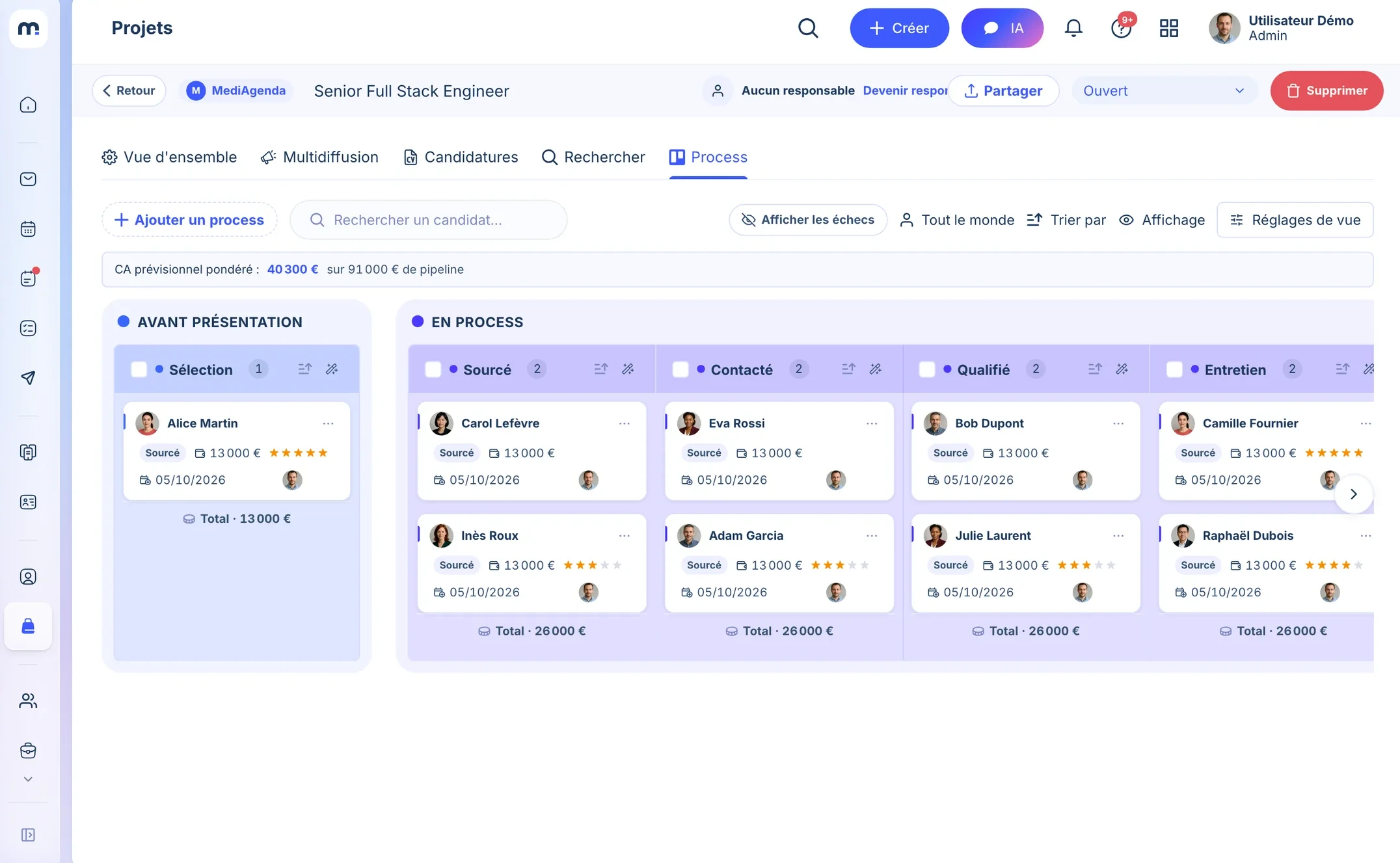
The assignment, stage by stage.
- The assignment's weighted revenue forecast.
- The process stages, as columns.
- One card per profile, at its stage.
Screenshot of the demo account, fictitious identities.
PresentationThe pack is still your signature. The layout is not.
Pack in your brandingThe manager's CV and profile are generated from their record, in your branding, with a first draft of the profile written by AI for you to review. Anonymous version in one click, PDF or Word export.All your packs come out with the same presentation, whoever prepares them.The assignmentFrom timesheet to invoice, without re-keying.
Assignment · timesheet · CashThe manager enters their days and expenses in their space. Your team approves, then the client signs online through a secure link; the invoice is generated from the approved timesheet and synced with Pennylane.Buy rate, sell rate and approved days on the same record: the margin reads by assignment, by manager and by client, during the assignment.
Day to day
A repurposed ATS,
spreadsheets around it.
And the assignment in the middle.
Marvin replaces an interim management firm's repurposed ATS and spreadsheets with a real assignment record: client, manager, dates, buy and sell day rates. Managers declare their own availability, profiles come out in your branding, the timesheet is approved online and the margin reads while the assignment runs.
- Client
- Aerolys
- Manager
- Antoine Lefèvre
- availability declared
- Dates
- 1 July → 31 December
- Buy · sell day rate
- €950 · €1,250
- Days approved
- 62
- timesheets signed
- Margin
- €300 a day · 24%
- during the assignment
The assignment fits on one record.
Demo, fictitious data.
Consolidation
Seven lines on your statement.
One licence.
One Marvin licence replaces an interim management firm's subscriptions: ATS and sales CRM, sourcing, assignment tracking and timesheets, email and phone enrichment, outreach and sequences, AI note taking and invoicing. It adds the managers' portal, two-step online timesheet approval and the margin per assignment.
A single licence
and more than your current stack
Per user, it covers the 7 lines opposite. And along the way you get the manager portal, double online timesheet approval and margin per assignment.
Each manager has their own space, opened through a secure link: availability, days, expenses and documents.
Prices seen at firms, per user per month. The names listed are examples of common tools for each line of spend.
- ATS and sales CRMBullhorn, Loxo, Tool4Staffing€130/ month
- SourcingLinkedIn Recruiter, Kalent, Talentfindr€300/ month
- Assignment tracking and timesheetsdedicated assignment management tool€60/ month
- Email and phone enrichmentKaspr, Apollo, RocketReach€45/ month
- Outreach and sequencesWaalaxy, lemlist€70/ month
- AI note takerNoota€30/ month
- InvoicingSinao€30/ month
7 subscriptions, €665 a month.
Sovereignty
Your managers, your clients.
No grey areas.
An interim management firm's data on Marvin is hosted in France, with Scaleway in Paris. In their space, the manager only sees their assignments, their days, their documents and their own day rate; the sell day rate and the margin stay on the firm's side. Every action is timestamped and attributed.
- Assignment
- Aerolys · since 1 July
- Days this month
- 18, entered by him
- to approve
- His day rate
- €950
- Documents
- Contract, expense claims
Demo, fictitious data.
Your data is hosted in France (Scaleway, Paris). Our sub-processors, including AI providers, are listed in our DPA.
Secrets and tokens encrypted with AES-256-GCM, traffic encrypted with TLS.
In their space, the manager sees their assignments, their days, their documents and their own day rate. The sell day rate and the margin stay on the firm’s side.
Every action is time-stamped and attributed: who presented which manager, when, and who approved which timesheet.
Strict isolation per firm, role-based permissions, sign-in by magic link, password, Google Workspace or Microsoft Entra ID (with Google or Microsoft, your identity provider’s two-factor authentication applies).
DPA (Art. 28), technical and organisational measures, continuity plan, sub-processor annex, AI System Card, in French and English. Your data stays exportable.
Migration
One month to move.
Without pausing your assignments.
Migrating an interim management firm to Marvin takes one month, without pausing your mandates. We collect the export from your tool, your assignment spreadsheets and your manager files; our data engineer merges duplicates and submits every rule to you. The switchover then happens within 24 hours.
Initial export
We help you get the export from your current tool and gather your other sources: assignment spreadsheets, manager files, invoicing history.

- marie.laurent@…
- duplicates merged
- Phone
- 06 •• •• •• 41
- kept from the other record
- Skills
- React, TypeScript
- filled in from the CV
- Rule
- Duplicate merge
- approved by you
Structuring and clean-up
Our data engineer audits the sources, merges duplicates between the talent pool and clients, and submits every rule to you. An AI fills in missing fields from the CVs. Your teams carry on in the current tool.
- Final export
- The past month
- carried over
- Go-live
- Within 24 hours
- database up to date
- Managers on assignment
- Invitation to their space
- sent
Switchover
Final export, live within 24 hours. Managers on assignment receive their invitation to their space.
Demo, fictitious data.
The trade in figures
Your market,
in public figures, sourced and dated.
Interim management was worth €800m in revenue in France in 2023, according to a Xerfi study for the France Transition federation. In the first half of 2025, the average daily rate of its member firms’ assignments was €1,330, for an average length of 6.85 months. Each figure links to the federation’s publication, in French, with its date.
- €800m
in revenue for interim management in France in 2023, up more than 16% a year since 2019 (Xerfi study)
Source: France Transition, Le marché du management de transition en France en 2024 (French source, in French), - €1,330
average daily rate of assignments in the first half of 2025, across the member firms of the France Transition federation
Source: France Transition, baromètre du 1er semestre 2025 (French source, in French), - 6.85 months
average assignment length in the first half of 2025, against 7.35 months over 2024
Source: France Transition, baromètre du 1er semestre 2025 (French source, in French),
Questions from interim management firms.
What software suits an interim management firm that needs a manager portal and timesheet approval?
Marvin brings together the pool of managers, assignments, the manager portal, timesheet approval and invoicing in a single tool. The manager enters their days in their space, your team approves, then the client signs online; the invoice is generated from the approved timesheet. Margin is tracked per assignment, per manager and per client.
Do interim managers really use a portal?
The Marvin manager space opens in a browser through a secure link, with no account or password to remember. The manager declares their availability, enters their days and expenses, and finds their documents there. They are invited automatically as soon as they are placed on an assignment.
Can an interim management firm keep the layout of its presentation profiles?
Yes. In Marvin, the CV and profile summary templates use your logo and colours, and every profile comes out identical, whichever consultant prepares it. An anonymised version takes one click, and export is in PDF or Word.
Can you search for an interim manager by availability, area and sector in Marvin?
Yes. Search filters by availability date, by city with a radius or by mobility area, by sector, by role and by years of experience, and also reads the text of CVs and notes. Desired or current pay can be filtered too. There is no dedicated filter for the size of the companies the manager has worked for: a filterable custom field can hold it.
Does Marvin handle contracts for interim management assignments?
Not today: Marvin does not generate assignment contracts or handle their signature. It covers the talent pool, the assignment, the timesheet signed online by the client, expenses and invoicing. Your contracts stay in your current tool.
How does an interim management firm migrate a talent pool spread across several tools?
A Marvin data engineer audits all your sources (old ATS, spreadsheets, assignment files), merges duplicates and submits every clean-up rule to you before the import. Nothing is loaded without your approval, and your teams keep working in the current tool during the preparation.
Do interim managers submit their expenses in Marvin?
Yes, from their space, once the feature is switched on by the firm: each claim has its category (travel, hotel, meals…) and its receipt, then your team approves it. A claim marked as rebillable is added to the client’s invoice. Marvin does not calculate mileage allowances on the official scale: the amount is entered as an expense.
In an interim management firm, does an office manager who only handles invoicing need a full licence?
They take a licence, like anyone who logs in to Desk, but their role limits what they see and can do, for example assignments and invoicing without candidates. The quote can include licence lines by profile, at their own rate. Managers on assignment and your clients take no licence at all: they use their own space and a link.
Does an interim management firm’s invoicing connect to its accounting tool?
Yes, in two ways: invoicing syncs with Pennylane, and exports as CSV for other accounting software. Invoices come from approved timesheets, rebillable expenses included, with the French legal mentions and the client’s purchase order number. For another accounting tool to connect directly, compatibility is checked during the demo.
Can you schedule a reminder to discuss extending an interim management assignment with the client?
Yes. A reminder is set directly on the assignment, on the chosen date, with a note, and flagged to you on the day; it can also be assigned to a colleague. A custom date field on the assignment, such as an extension review date, can even generate its reminder automatically, without anyone having to think about it.
Do automatic write-ups work for a reference check done by phone?
Only if the call goes through Aircall: it then arrives on the manager’s or contact’s record, with its recording and its transcript when Aircall produces one. Note, for its part, joins Zoom, Meet and Teams video calls as a participant. A face-to-face conversation or a call on a phone not connected to Marvin produces no automatic write-up.
Does the interim manager see the firm’s margin on their assignment?
No. In their space, the manager sees their assignments, the days they have entered, their expenses and their documents, with their own day rate. The rate billed to the client and the firm’s margin stay on the team’s side, visible according to each role’s permissions, and tracked per assignment, per manager and per client.
30 minutes on your live assignments.
And your available managers.
Updated